Building product sense at HelloPM · Assignment 1 · Cohort 51 · Solo PM and builder
HelloFresh
A three-phase product study, from teardown to prototype
The clickable prototypes: explore inside. Open in a new tab ↗
Problem statement
Long-tenured HelloFresh subscribers, the ones who have only just become profitable to keep, leave quietly: skipping, then cancelling, without a complaint. Price is the loudest signal, but it is rarely the root cause.
Research through to a full PRD and four clickable prototypes. The primary build turns an unstructured support ticket into data the business can act on.
Highlights
- 132
- Survey respondents
- 6
- User interviews
- 4
- Problems scored
- 4
- Clickable prototypes
Problem Statement
How it started
The brief was to pick a product, investigate it like a detective, learn from real users, find the one problem worth solving, and design the answer end to end.
Domain advantage
I had worked in this category before the assignment began.
I helped a friend operate a meal-planning business that set out to launch South Indian meals for students and working-class people.
That work built first-hand knowledge of:
- The category
- The logistics
- The customer pain points
HelloFresh was the company we looked up to as the successful player in the space, which made it the natural subject for a deep retention study.
The problem
A retention study of HelloFresh, a meal-kit subscription. The audience is existing subscribers, not prospects. The business problem is that long-standing subscribers, the ones who got past the risky early months and have only just become profitable to keep, leave without ever making a complaint.
The silent churn
- Who leaves
- Long-tenured subscribers, the highest-value cohort
- When
- Soon after they become profitable to keep
- How
- Skipping, then cancelling, without a complaint
Every week: “Is this box still worth it?”
📚 The Assignment
Three-phase product study
Pick a product you use. Study it for three weeks across three phases: understand the product and its category, learn from real users through primary research, then turn the sharpest problem into a working solution with a complete PRD.
⚪ Problem
HelloFresh subscribers who survive the risky early months and become profitable to retain are leaving without complaint. The loudest signal in every public forum is price, but price is almost never the root cause, making it a problem worth investigating properly.
Research & Insights
The product and the category
HelloFresh is a meal-kit subscription service. I chose to study existing subscribers, not prospects. The category is mature: the growth story is over, and the companies that remain are fighting to keep the subscribers they have. That made retention the right lens.
What I owned in the product study
- Product teardown. The product itself, the competitor set and the category trends.
- User mapping. Understanding who the subscriber base is, beyond prospects.
- Problem identification. Setting a goal around retention (not acquisition) and identifying the initial problems worth probing.
The goal I set
Understand why long-tenured subscribers, the ones past the risky early months who have only just become profitable, leave without complaint. Narrow that down to a short list of problems worth taking into primary research.
Download the research
What subscribers actually said
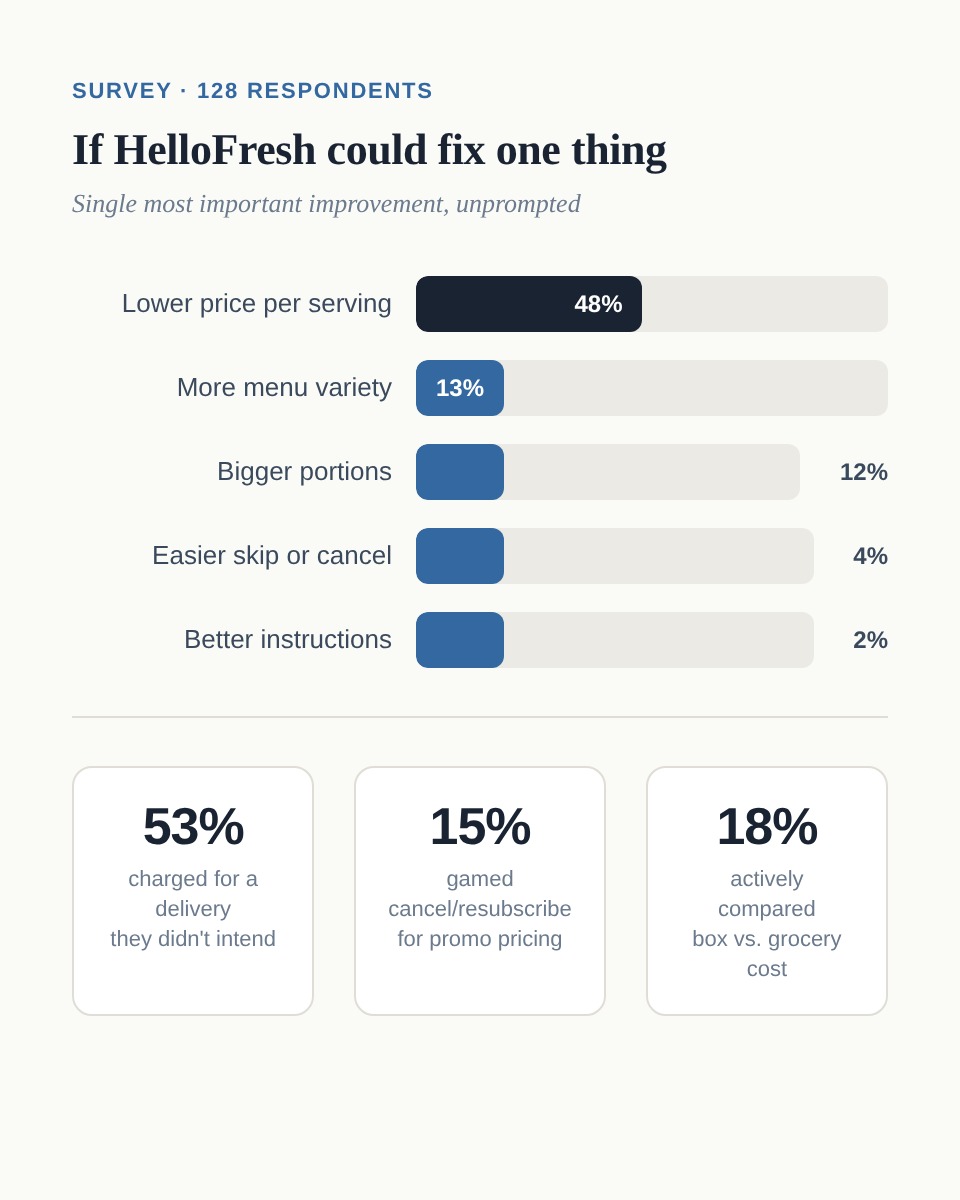
132 survey respondents, plus interviews and a Reddit thread of cancellation posts.
What did I find?
- 53 per cent had been charged for at least one delivery they did not intend to receive.
- 48 per cent named a lower price as the single fix they wanted.
- 18 per cent actively compared the box against grocery costs.
- 15 per cent gamed the cancel and resubscribe cycle to get new-customer pricing.
Price was the loudest complaint. It was not the root cause, and the rest of the study is about why.
Five causes under one complaint
Subscribers struggle to keep feeling the per-serving price is worth paying, week after week. Five things drive that, and only one is addressable by a product change.
- Ingredient quality quietly declines and is unverifiable by the subscriber.
- The price gap versus groceries widens with each increase.
- Accumulated subscription value is invisible.
- Long-tenured subscribers feel unrecognised next to discounted new customers.
- The weekly skip decision repeats with no proactive intervention point.
Only the first can be fixed by a feedback mechanism, which is why Food Quality Feedback became the primary build rather than a discount.
Solution & Process
See the deliverables
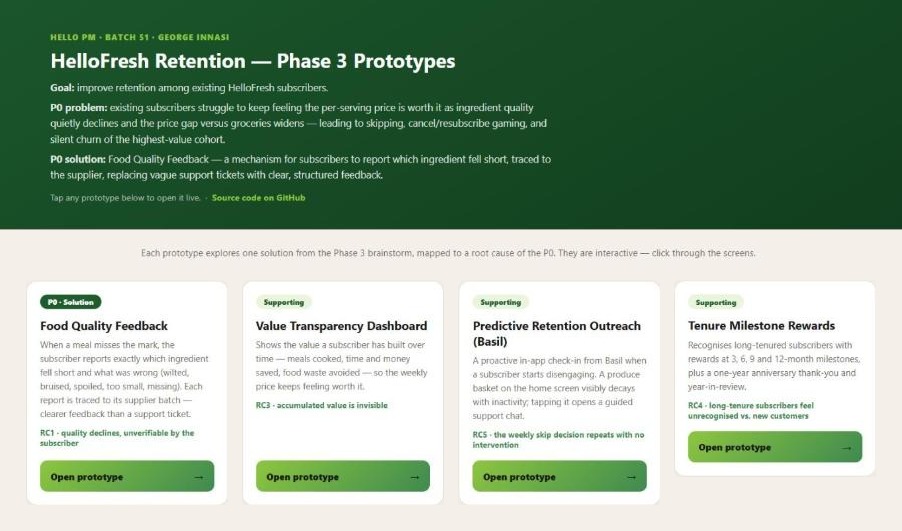
Food Quality Feedback, and three supports
The primary build converts an unstructured support ticket into data the business can act on.
- Food Quality Feedback. Subscribers report a specific ingredient issue, wilted, bruised or spoiled, traced to the supplier batch.
- Accumulated value dashboard. Meals cooked, time saved, money saved, waste avoided, surfaced at the moment of the weekly skip decision.
- Basil, a proactive assistant. In-app check-ins with subscribers who are disengaging, rather than waiting for the cancellation flow.
- Milestone recognition at three, six, nine and twelve months, for the long-tenured subscribers sitting beside discounted new customers.
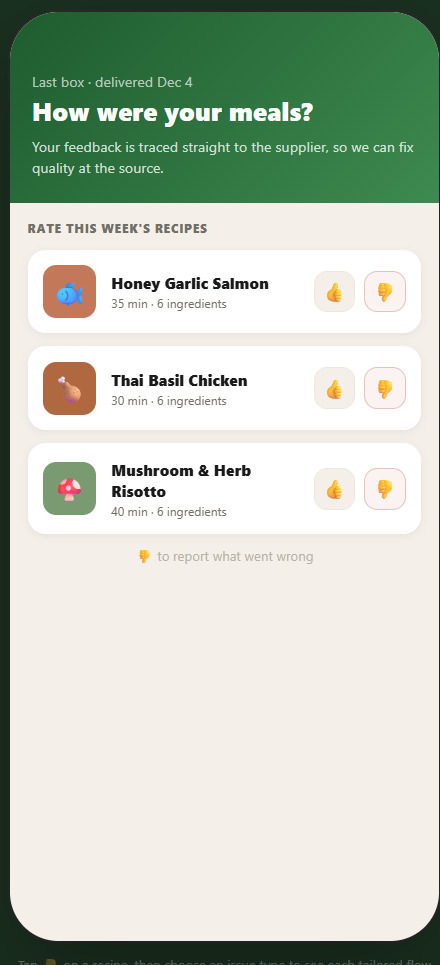
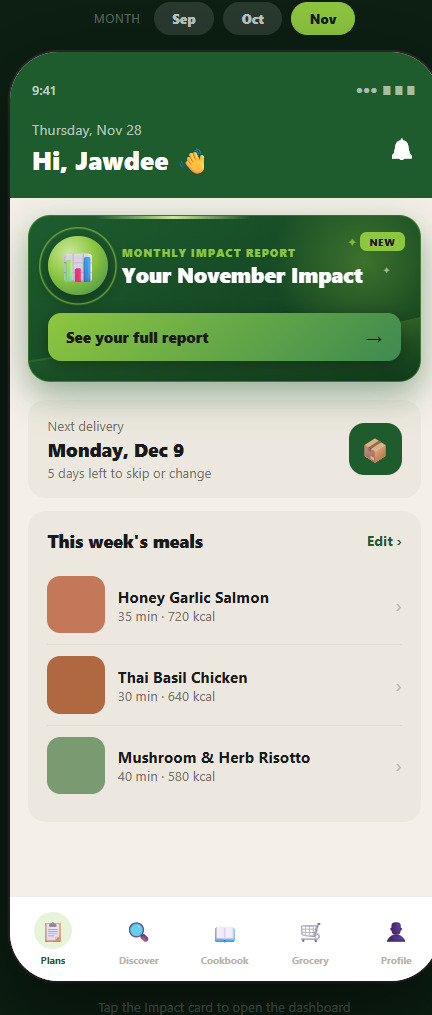
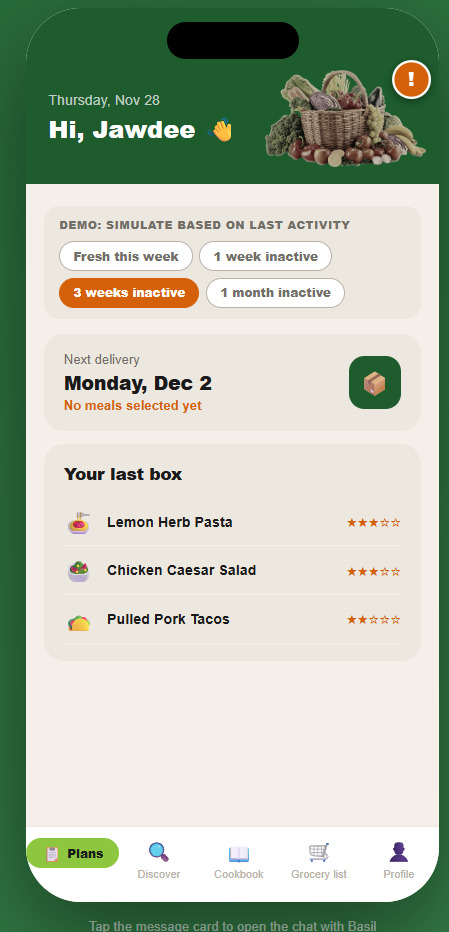
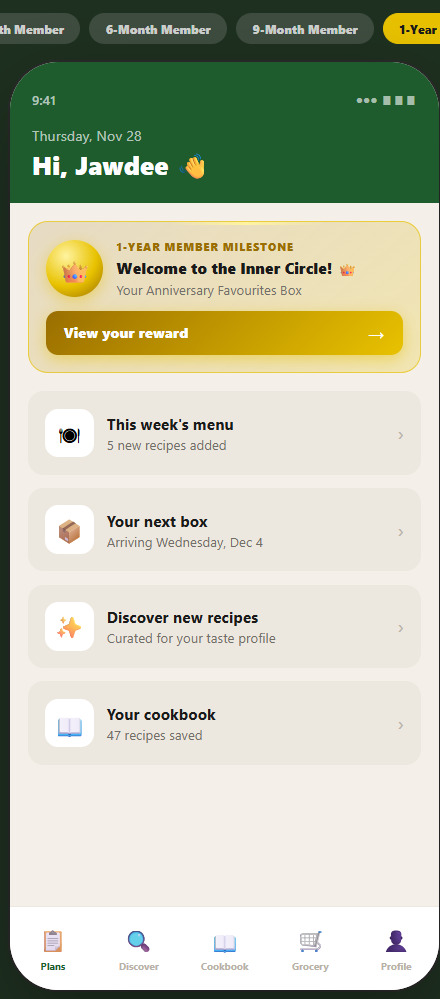
Planning & discovery: retention analysis whiteboard
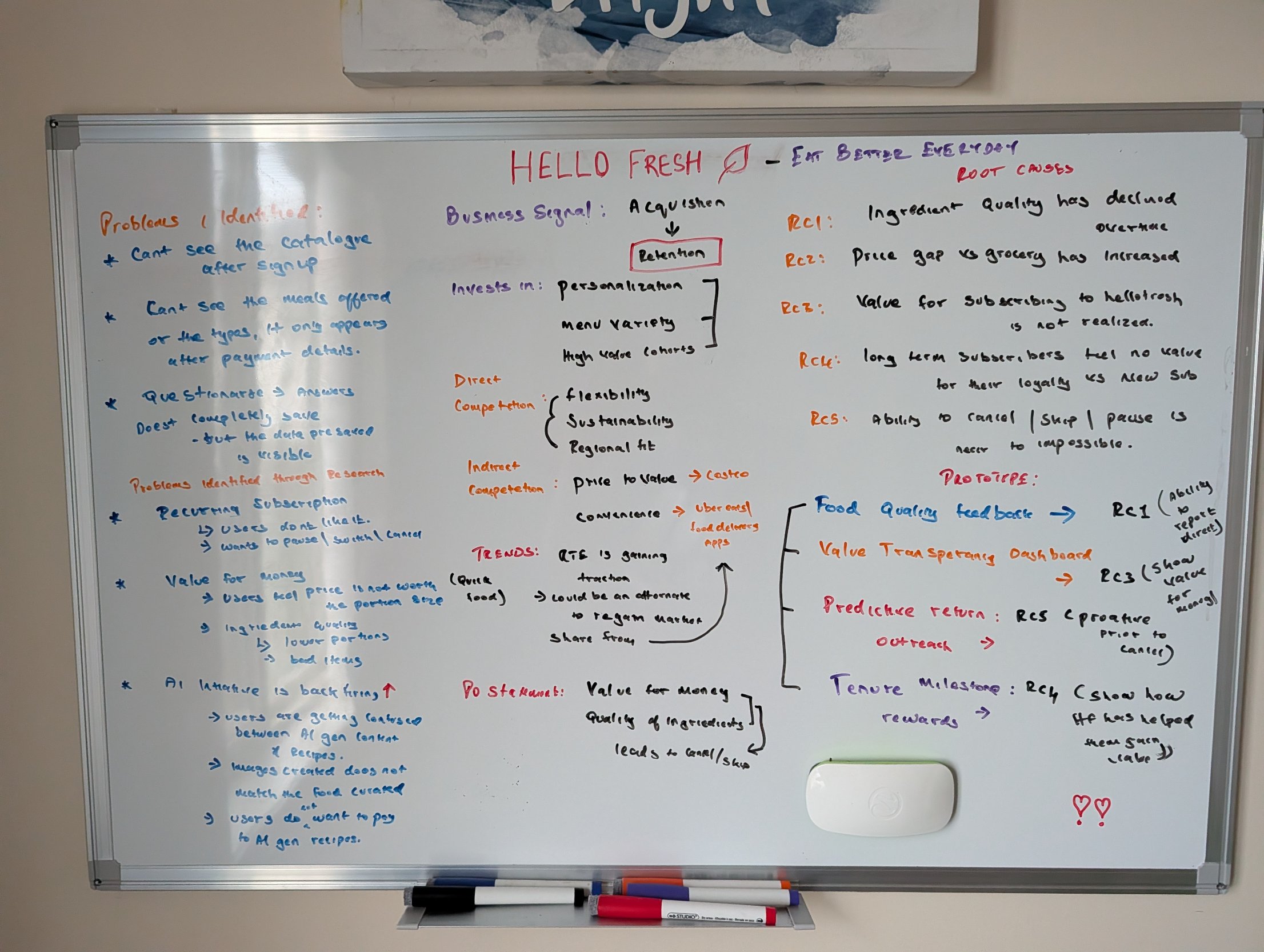
Working session mapping the five root causes of churn, subscriber segments by tenure, and the first sketches of the Food Quality Feedback flow and the Value Dashboard before they moved into prototypes.
Impact & Metrics
| Problem | Score |
|---|---|
| P0Cannot justify per-serving price as quality declines and the grocery gap widens | 13/15 |
| P1Charged for deliveries not intended, due to a narrow opt-out skip window | 11/15 |
| P2AI-generated recipe content eroding trust in what subscribers pay for | 11/15 |
| P3Weekly menu offering too few genuinely appealing recipes | 10/15 |
Four confirmed problems, each scored out of 15 on population, intensity and frequency.
The two elevens were separated on evidence quality rather than the total. The accidental charge is sharp and trust-breaking but episodic. The AI content problem is high intensity in a vocal segment, and its population score was inference rather than measurement, which is stated rather than hidden.
Reflection
What I deliberately parked
- Delivery failures. More than five cancellations named delivery, across three countries. Parked because the cause sits in courier partnerships, not the product.
- Loyalty pricing inequity. Parked because the fix sits in pricing strategy rather than the product.
An independent analysis using public information and self-fielded research. Not affiliated with HelloFresh.