HelloPM Buildathon · Built solo from scratch
Side Quest
Volunteering that fits around classes
Problem statement
Undergraduates in their first to third year who want to explore different causes struggle to find suitable, low-commitment volunteer options in one place, because existing aggregators and recruitment systems are built to fill specific NGO rosters or serve the general public, not to give students personalised feeds.
A volunteering platform that matches UG sophomores with Quests nearby their home or college based on their interests and availability.
Highlights
- Top 5
- HelloPM Buildathon
- 6
- Pilot users, live
- 37
- Listings across 12 NGOs
- Solo
- Built in Aug to Sep 2026
What I owned
- Discovery & Problem Framing. Designing the survey, running four user interviews, auditing the competitors and defining the problem statement before writing any code.
- Product & AI Architecture. Designing a rules-based matching baseline with Gemini 2.5 Flash re-ranking on top, backed by a Neon Postgres data layer, and deciding what to cut before the deadline.
- Full-Stack Prototyping. Building the screens, server logic, database and deployment solo, with v0 generating the first Next.js version and Claude as my coding partner to extend and debug it.
- Live Pilot & Validation. Recruiting six users, running a live pilot on 37 listings across 12 NGOs, collecting the feedback and presenting the results.
I took Side Quest from first interview to a live pilot as the only builder, with no engineering team, in August and September 2026.
How it started
Charu's search raised a question I could not let go. If someone with a decade of volunteering history finds the route in this exhausting, how do first and second year students find it at all?
That question became the project. Not a lack of supply, but a failure of distribution: the opportunities exist, the intent exists, and the path between them is broken.
The product
Side Quest is a student micro-volunteering platform for undergraduates in their first to third year in Chennai. It matches them to local causes by interest, availability and travel distance.
The problem it addresses is distribution, not supply. Opportunities exist and students want them, but the route in is invisible, so intent decays before any platform returns an answer.
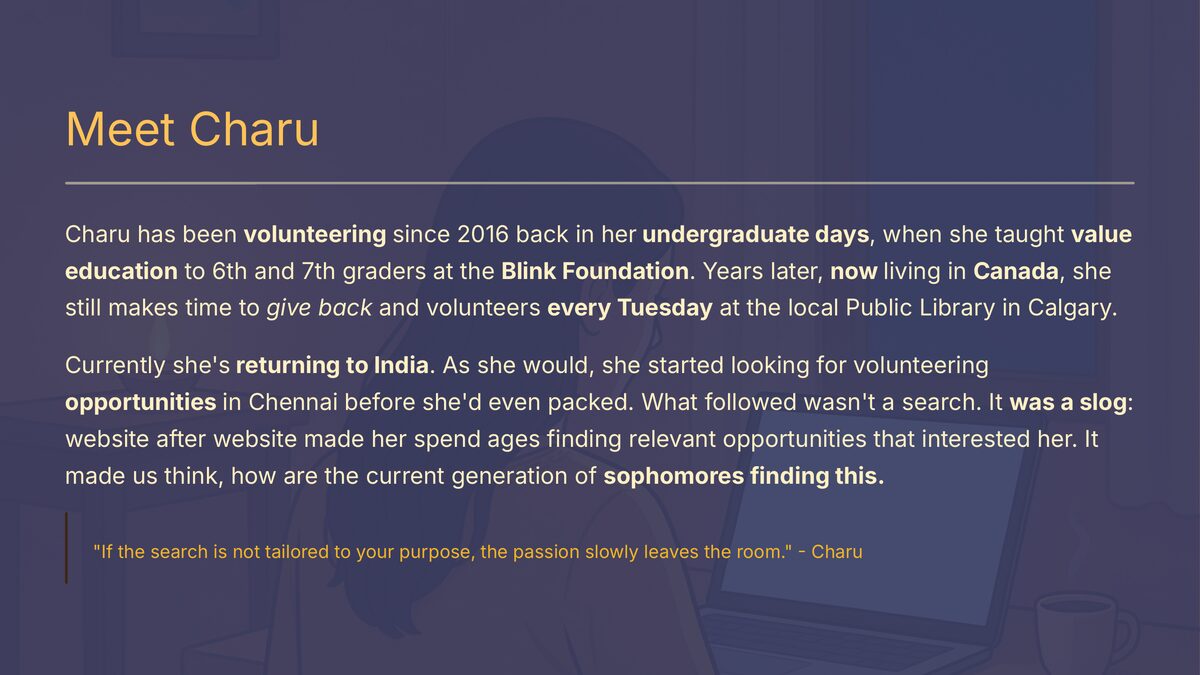
Proving It’s a Distribution Problem, Not an Intent Problem
Discovery
User interviews and survey
All interviews followed the Mom Test: no leading questions, only what people had actually done.
The gap was finding out, not caring. Students assumed the opportunities simply did not exist.
Schedule collisions. Dropouts spike at term resets, because static commitments cannot flex.
Motivation
What actually motivates them
Students don’t volunteer for resume fodder. They volunteer for the organization and sense of belonging.
That reading changed what I built. A platform selling volunteering as resume material would be aimed at the smallest motivation in the set. The portable record still matters, but as a by-product rather than the pitch.
Where existing platforms fall short
I ran a live audit of Indian volunteer platforms in September 2026 to see what existing platforms actually do.
What did I find?
- Built for NGO rosters. Current user flows are defined for NGO rosters and CSR reporting, not for a student choosing how to spend a free afternoon.
- Excessive gating. One platform asked for job title and building number before showing a single listing, requesting information that does not fit my user segment.
- Broken data filters. iVolunteer listings were outdated, relying on traditional flows of submitting info via email and WhatsApp groups. Another platform's Chennai filter returned results in Dadri and Mumbai, and a third showed expired 2024 events inside a 2026 window.
- No student-first discovery. None organise by student interest, schedule or availability.
Existing platforms vs Side Quest
| MY Bharat | NGO aggregators | Side Quest | |
|---|---|---|---|
| Organised by student interest | ✗ | ✗ | ✓ |
| Matches to a free schedule | ✗ | ✗ | ✓ |
| Ranks by travel distance | ✗ | ✗ | ✓ |
| Personalised feed | ✗ | ✗ | ✓ |
Hybrid AI Matching: Rules-Based Speed with Gemini Reordering
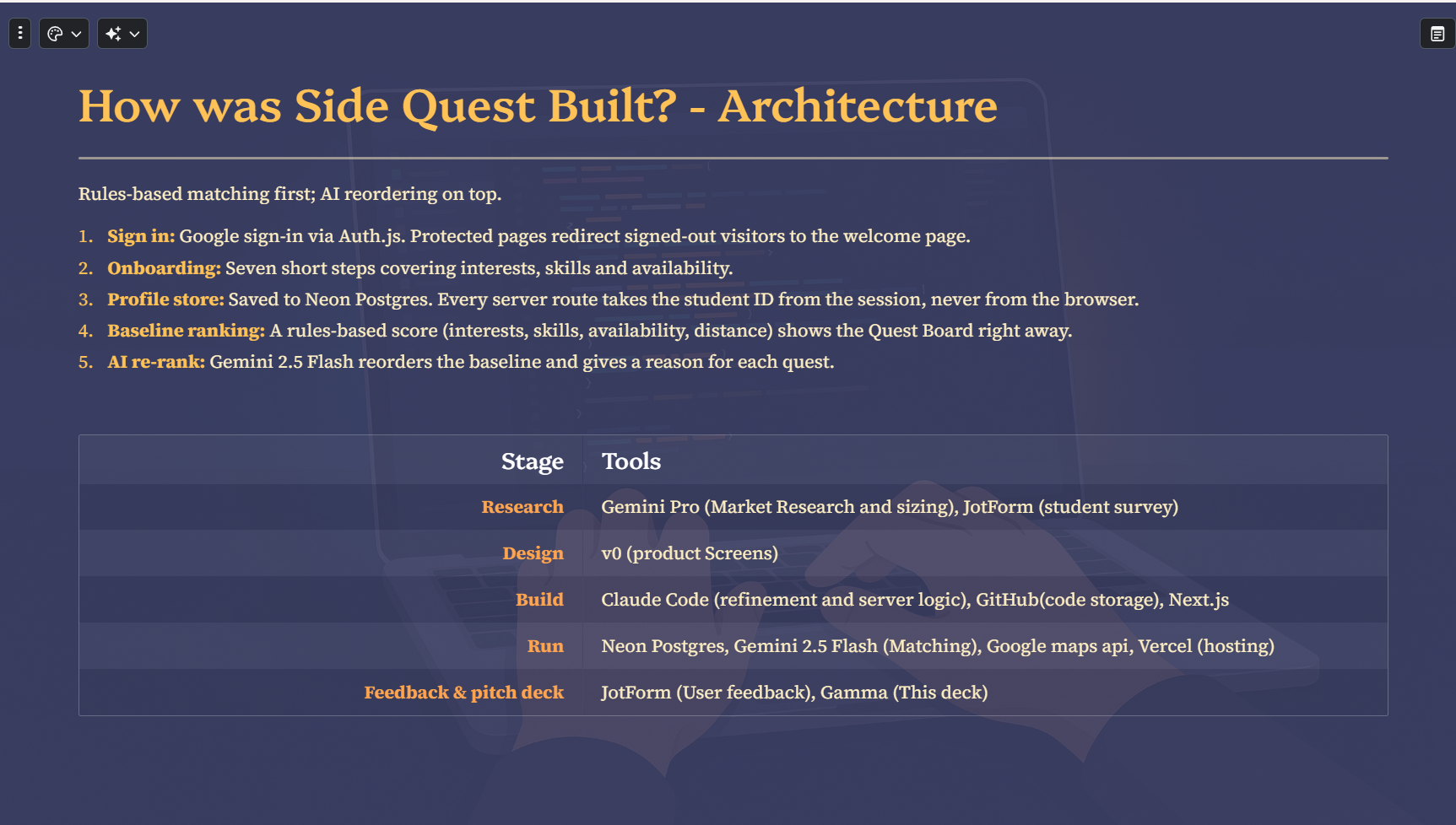
Architecture
How Side Quest was built
- Rules-based baseline. A score across interests, skills, availability and distance renders the quest board immediately.
- Gemini 2.5 Flash reordering. The model then reorders the board and supplies a reason for each quest.
- 1.5 second latency fallback. If the model is slow or unavailable, the baseline board stays useful and the fallback takes over once latency passes 1.5 seconds.
North star: confirmed quest starts. A student matched, attended, and logged their first civic hour. It sits past sign-up on purpose, because the usual failure is students who register and never turn up.
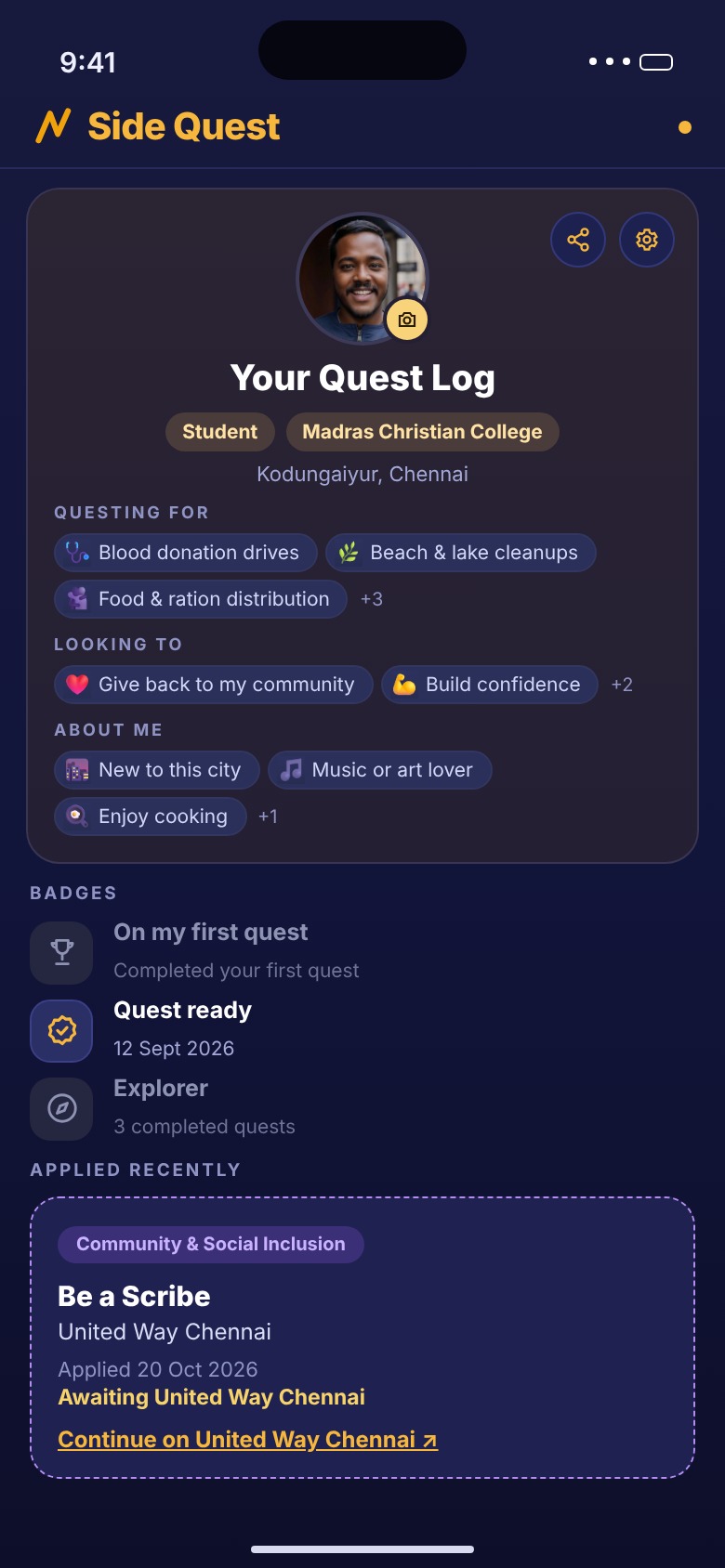
Feature
Quest Log
What it is. A shareable profile card that students can send to friends, family or prospective employers, consolidating everything that matters into one portable record.
What it shows. Causes the student is questing for, personal motivations, impact hours logged, quests completed, quest lines across organisations, and earned badges.
The insight behind it. Hours, milestones and verified badges should aggregate into one cross-organisational log rather than sitting as PDF certificates inside one NGO. A student who volunteers across three organisations should not need three separate proofs.
Pilot Learnings: What 6 Students Taught Me & HelloPM Recognition
Pilot cohort
What six students reported
Retention intent was unanimous. All six would return within a month, and all six found account creation very easy.
Schedule fit was the weaker signal. Interest matching landed, but only 37 quests was too thin for availability filtering to work.
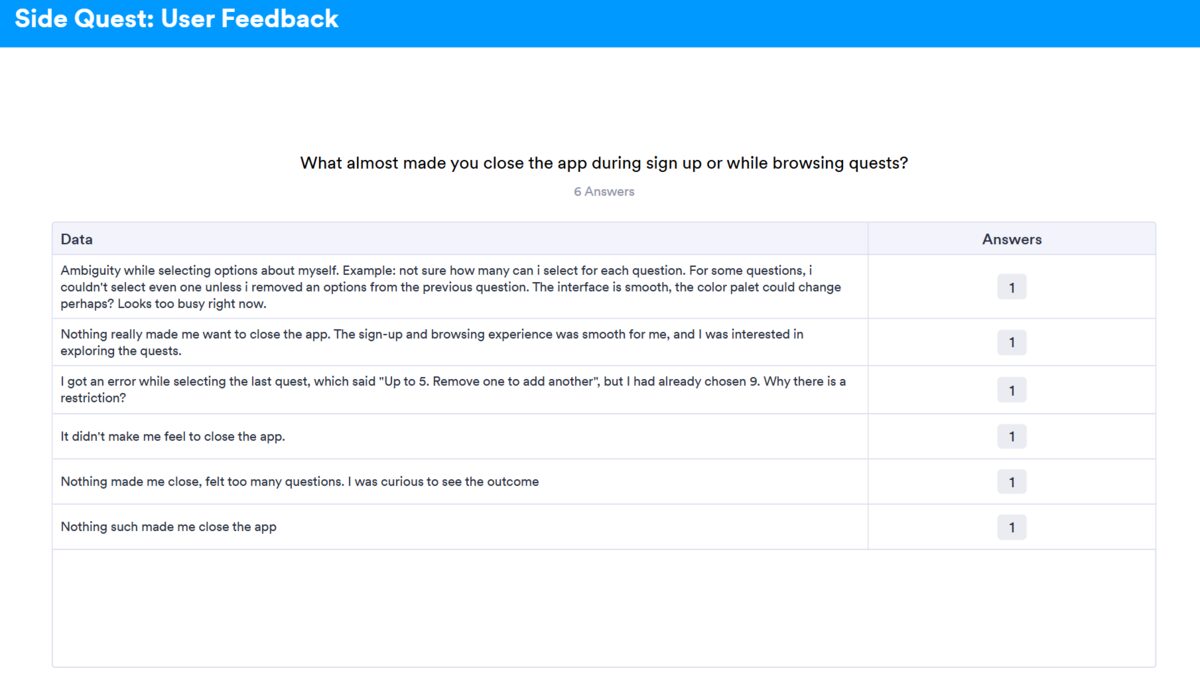
User feedback
What it exposed
The redirect breaks the flow
“While trying to select the organization, it redirects to their page and I had to re-sign up with all my details. Can it not be pre-filled?”
Acted on: the redirect is why direct apply is the next build.
An unexplained limit
“I got an error saying ‘Up to 5, remove one to add another’, but I had already chosen 9. Why is there a restriction?”
Recognition
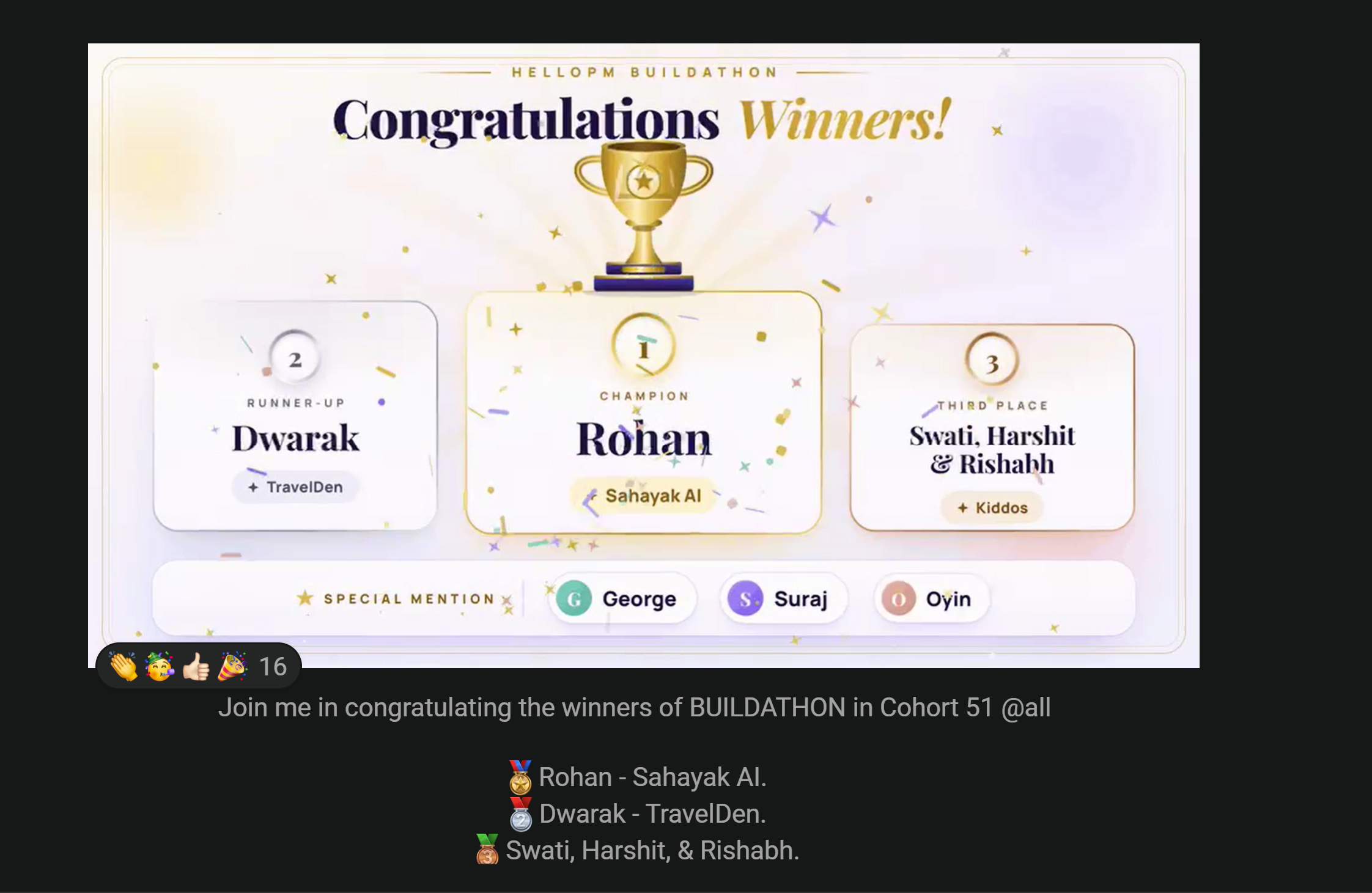
Top 5, HelloPM Buildathon, Cohort 51
Side Quest placed in the top five, recognised alongside the top three finishers for its pilot execution and real user validation.
PM Reflection: What Validating the Student Flow with Six Users Taught Me
Roadmap
Four priorities, in order
The roadmap is sequenced by what the pilot exposed. Direct apply and cohort feedback close defects six real users found. Live matching and AI reordering extend what already works.
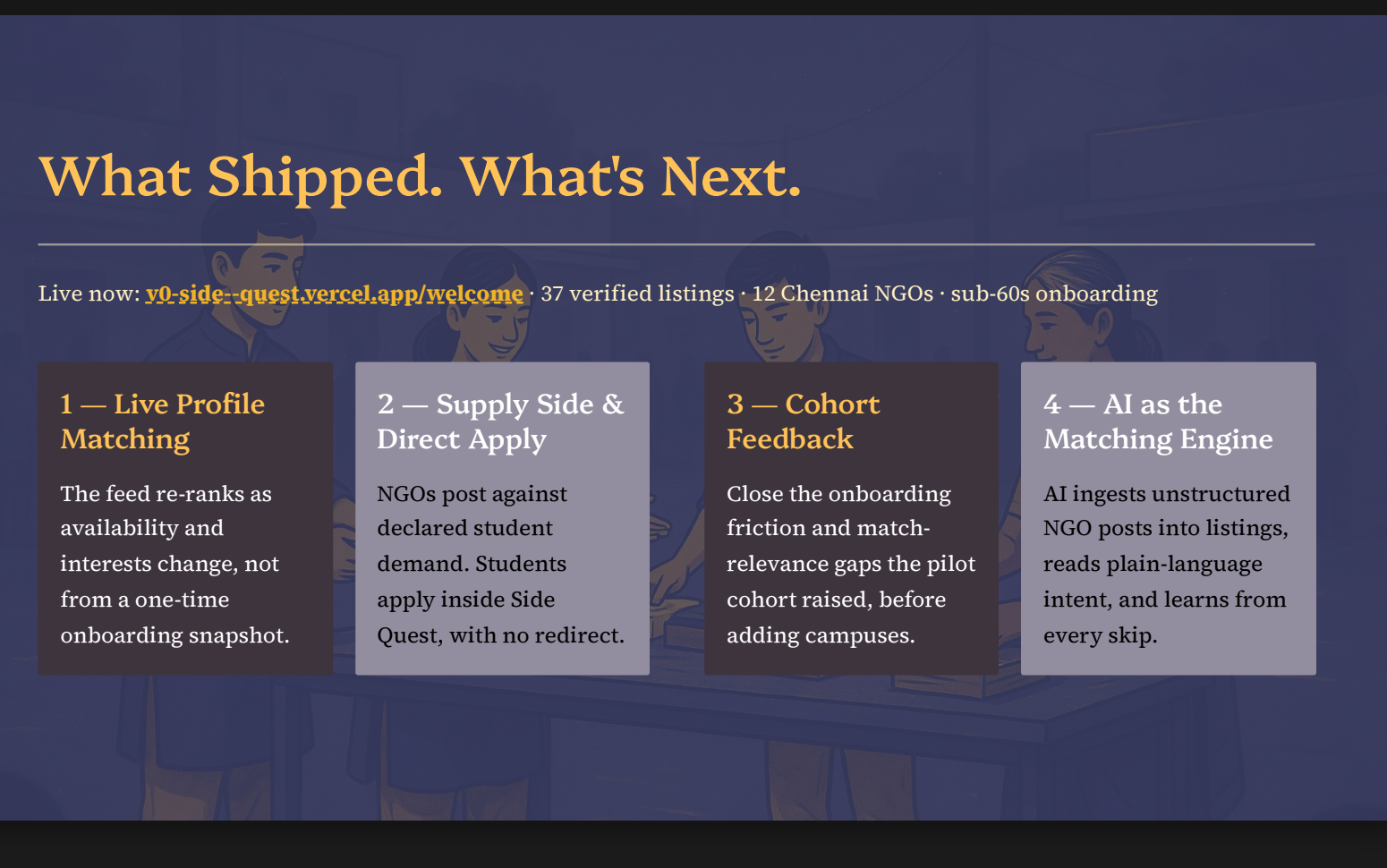
- 1Live Profile Matching. The feed re-ranks as availability and interests change, not from a one-time onboarding snapshot.
- 2Supply Side and Direct Apply. NGOs post against declared student demand. Students apply inside Side Quest, with no redirect.
- 3Cohort Feedback. Close the onboarding friction and match-relevance gaps the pilot cohort raised, before adding campuses.
- 4AI as the Matching Engine. AI ingests unstructured NGO posts into listings, reads plain-language intent, and learns from every skip.
The rule. Fix the first campus before adding a second. No expansion until the first cohort reaches 50 active students and the redirect problem is gone.
Scope of the pilot. The pilot validated the student experience only: sign-up, matching and applying. Organisation workflows were deliberately out of scope for v1 and are the next area to explore.
Honest status. Side Quest is a working pilot, not a finished product. The listings and organisations are real, but I gathered them by hand at one point in time. Six pilot users is enough to find defects and nowhere near enough to claim product-market fit.